

Bismuth melanin biomaterial shields body from radiation and eases acute radiation syndrome
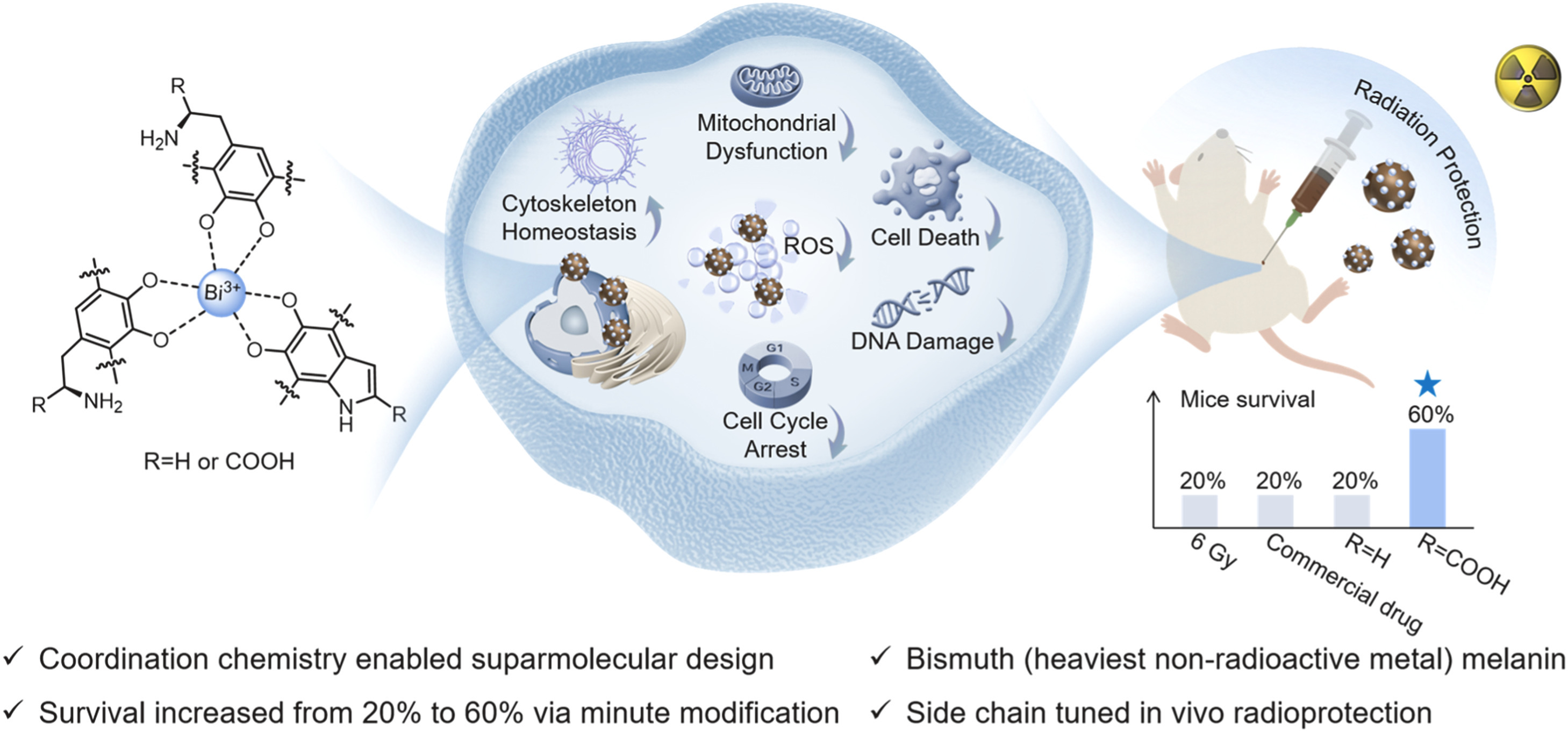
Schematic of coordination enabled in vivo radioprotective bismuth melanin material for alleviating acute radiation syndrome.
GA, UNITED STATES, April 28, 2026 /EINPresswire.com/ -- Researchers created a bismuth coordinated melanin material that provides in vivo physical radiation shielding and ROS scavenging. It markedly mitigates acute radiation syndrome and boosts mouse survival from 20% to 60% after lethal total body irradiation.
Radiation exposure in medical treatment, industry, space and emergencies can trigger life‑threatening acute radiation syndrome (ARS), marked by hematopoietic failure and organ damage. Most current radioprotectants only clear reactive oxygen species (ROS) and lack direct physical shielding inside the body.
In a new study published in Supramolecular Materials, a team led by Prof. Wei Cao at Beijing Normal University designed a bismuth‑coordinated melanin (Bi‑melanin) radioprotective material using supramolecular coordination chemistry. This material combines high‑Z bismuth for physical photon shielding with natural melanin’s strong ROS‑scavenging ability.
“Traditional in vivo radioprotection mostly targets oxidative stress, but we brought external high‑Z shielding into the body for the first time with a safe supramolecular strategy,” says Cao. “Bismuth is the heaviest non‑radioactive metal, and melanin is biocompatible—their coordination creates a dual‑function protector.”
The team found that Bi‑P(L‑DOPA)—bismuth coordinated with poly L‑3,4‑dihydroxyphenylalanine melanin—showed stronger shielding and antioxidant effects than its polydopamine analogue, owing to its extra carboxyl coordination sites and better dispersion.
“In mouse experiments, a single dose of Bi‑P(L‑DOPA) before and after 6 Gy total body γ‑ray irradiation improved 30‑day survival from 20% to 60%,” shares Cao. “It preserved blood cell counts, protected bone marrow, spleen and intestine, and maintained normal organ structure without obvious toxicity.”
“This work opens a new path for in vivo physical radioprotection,” says first author Dr. Ruotong Deng. “The material is safe and effective against ARS, with great potential for clinical radiotherapy and nuclear emergency protection.”
The team plans to further optimize the material and explore translation toward clinical applications.
References
DOI
10.1016/j.supmat.2026.100134
Original Source URL
https://doi.org/10.1016/j.supmat.2026.100134
Funding Information
National Key Research and Development Program of China (2022YFA150590); National Natural Science Foundation of China (22205026, 22471021); Fundamental Research Funds for the Central Universities.
Lucy Wang
BioDesign Research
email us here
Legal Disclaimer:
EIN Presswire provides this news content "as is" without warranty of any kind. We do not accept any responsibility or liability for the accuracy, content, images, videos, licenses, completeness, legality, or reliability of the information contained in this article. If you have any complaints or copyright issues related to this article, kindly contact the author above.
